What Causes Fence Posts to Lean (And How We Fix It)
A leaning fence post is one of those things you notice one morning and can't stop noticing after that.
Maybe it's subtle at first. A slight tilt that makes you think you're imagining it. Then a few weeks later it's more obvious. Then the sections on either side start pulling out of alignment and suddenly you have a fence problem instead of a post problem.
We get calls about leaning posts constantly in Killeen. It's one of the most common fence repair issues we deal with, and it's also one of the most misunderstood. Most homeowners assume a leaning post just needs to be straightened and re-secured. Sometimes that's true. But the post itself is rarely the whole story.
Here's what actually causes fence posts to lean in Central Texas, and what it takes to fix the problem the right way.
The Ground Is Usually the Real Culprit
When a fence post leans, most people look at the post. The real answer is almost always in the ground around it.
Fence posts depend entirely on the stability of the soil holding them in place. When that soil shifts, loosens, or erodes, the post moves with it. No post, regardless of how well it was installed originally, can stay plumb in ground that no longer supports it.
In Killeen, the soil itself creates specific challenges that don't exist everywhere.
Killeen's Soil Is Highly Reactive
Central Texas sits on a belt of expansive clay soil. Clay soil behaves differently from sandy or loamy soil in one critical way. It swells when it absorbs water and shrinks when it dries out.
In Killeen's climate, that cycle happens constantly. Heavy spring rain saturates the clay and causes it to expand. Summer heat then dries the same clay and causes it to shrink and pull away from whatever is embedded in it. Fence posts go through that expansion and contraction cycle every single year.
Over time that repeated movement works the post loose the same way that wiggling a stuck object back and forth eventually frees it. The hole that once gripped the post tightly becomes slightly larger with each cycle. The post develops a little play. That play becomes a lean.
Soil Erosion Around the Base
In yards with any slope or grade, heavy rain washes soil away from the base of fence posts over time. The post that sat firmly in packed soil eventually sits in a wider, shallower hole as erosion removes the material supporting it.
This is especially common along fence lines that run across a slope or near areas where water drains after heavy rain. The posts in low points and drainage paths take the most erosion pressure.
Improper Installation Creates Problems That Show Up Later
Not every leaning post is the result of soil and weather alone. Sometimes the installation itself plants the seeds of the problem.
Posts Set Too Shallow
Post depth is one of the most important factors in a fence installation. The standard rule for fence posts is to set them at a depth equal to one third of the total post length. For a six-foot fence, that means posts going roughly two feet into the ground.
Posts set shallower than that simply don't have enough soil contact to stay stable over time. They may look fine for the first year or two. Then the soil movement starts working on them and the shallow depth gives them nowhere to go but sideways.
In Killeen's reactive clay soil, shallow posts fail faster than they would in more stable ground. The soil movement we described above has more impact on a post with less depth holding it in place.
Concrete That Wasn't Mixed or Placed Correctly
Concrete is used to set fence posts in most professional installations. When it's mixed and placed correctly, it creates a solid anchor around the post base that resists soil movement.
When it isn't, it creates a false sense of security. Concrete that was too wet when poured, poured in wet soil without proper drainage, or not allowed to cure fully before load was applied can crack and crumble over time. A cracked concrete footing gives soil movement a path to work against the post.
There's also a common mistake worth mentioning. Concrete set flush with or above ground level traps water against the wood post base instead of letting it drain away. That trapped moisture accelerates rot at the most vulnerable point on the post.
Wood Rot Weakens Posts From the Inside Out
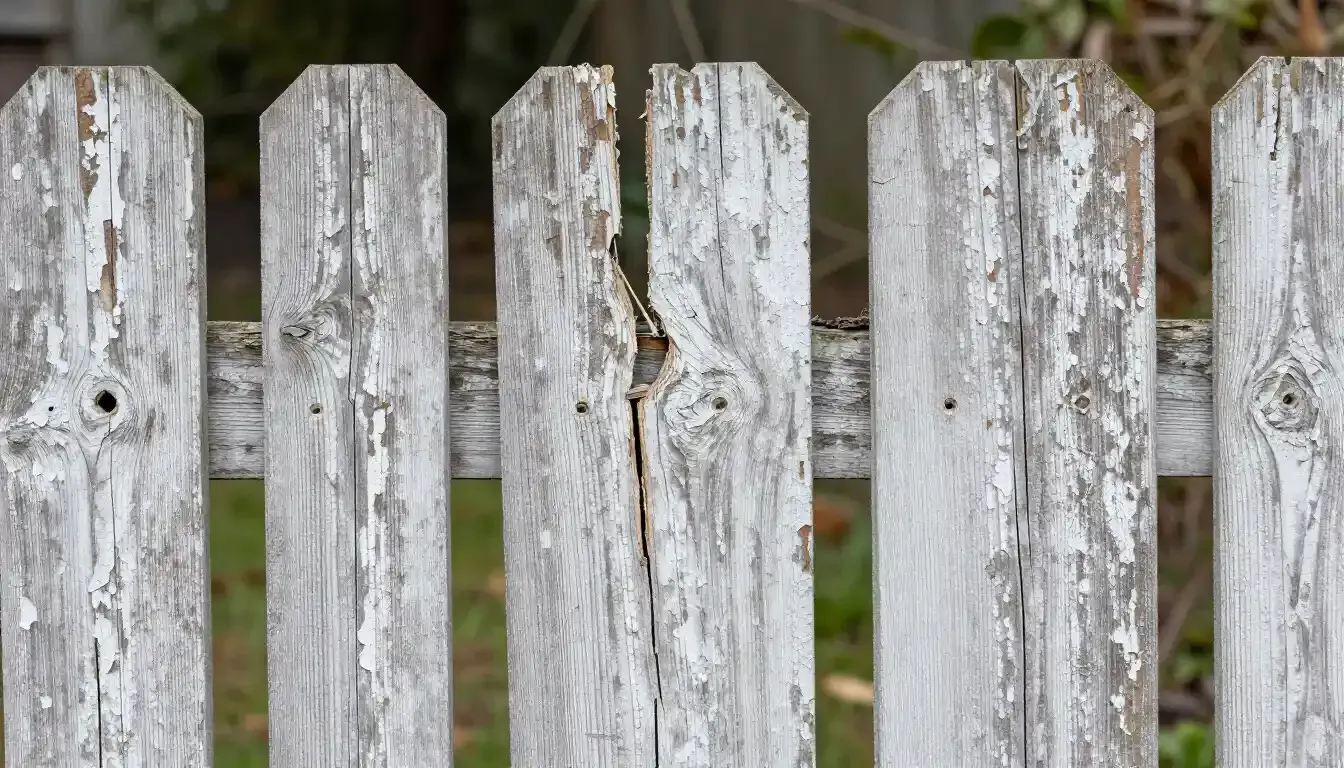
A post can lean for structural reasons even when the soil around it is perfectly stable. Wood rot at ground level compromises the post itself rather than its foundation.
As we covered in previous posts, the ground level transition zone is the most punishing environment for a wood post. Moisture, heat, fungal growth, and insect activity all concentrate right at the point where the post meets the soil. A post that is rotting at its base loses structural integrity gradually until it can no longer support the weight and wind load of the fence attached to it.
The deceptive part of post rot is how it hides. A post that looks completely solid above ground can be rotted through at the base. The outer shell of the wood holds its appearance while the interior breaks down. Push the post and it feels fine. But the actual structural strength is gone.
By the time a rotted post starts to lean visibly, the damage is usually significant. The lean is the last symptom, not the first sign of trouble.
Wind Load Does More Damage Than People Realize
Killeen sees real wind during spring and summer storm season. Gusts during strong thunderstorms regularly hit 50 miles per hour or more. Every time the wind pushes hard against your fence, that force transfers down through the fence panels and rails directly into the posts.
A fence post is essentially a lever. The fence panel above ground is the lever arm. The longer and taller the fence, the more mechanical force wind transfers to the post base underground. Posts that are already slightly compromised by soil movement or early rot feel that wind load more than solid posts do.
Over time, repeated strong wind events gradually push a compromised post further out of plumb. Each storm moves it a little more until the lean becomes visible.
This is why posts on the windward side of a fence often show lean before posts in more sheltered locations. They've taken more cumulative load over the life of the fence.
How We Diagnose a Leaning Post
When we get called out for a leaning post repair in Killeen, we don't just look at the post that's leaning. We assess the full picture before recommending a fix.
We check:
- How much the post has moved from plumb and in which direction
- Whether the post itself is structurally sound or compromised by rot
- The condition of the concrete footing if one is present
- The soil conditions around the post base
- Whether neighboring posts are showing early signs of the same issue
- What the fence sections attached to the post look like after the movement
That assessment tells us whether we're dealing with a soil issue, an installation issue, a rot issue, or some combination of all three. The fix depends on the diagnosis.
How We Fix Leaning Fence Posts
There is no single fix that works for every leaning post situation. The right repair depends on what caused the lean in the first place.
[H3] Resetting a Structurally Sound Post
If the post itself is solid but the soil or footing has failed, the post can often be reset rather than replaced. This involves excavating around the post base, removing the old failed concrete if present, repositioning the post to plumb, and resetting it with new concrete placed and finished correctly.
Done right, a reset post in stable new concrete can last as long as a new post. Done wrong, it leans again inside of two years.
Replacing a Rotted Post
If the post has significant rot at the base, resetting it is not a real solution. A rotted post put back in the ground in new concrete is still a rotted post. It will continue to fail regardless of how solid the new footing is.
Rotted posts need to be replaced with new material. We remove the old post and footing, prepare the hole correctly for Killeen's soil conditions, and set a new post with proper depth and drainage to give it the best possible foundation.
Addressing the Root Cause
If soil erosion is contributing to the lean, we address the drainage issue as part of the repair. If shallow installation caused the problem, new posts go deeper. If improper concrete placement was the issue, we correct the footing approach when we reset or replace.
Fixing the symptom without addressing the cause just means the same problem comes back sooner than it should.
Can You Fix a Leaning Post Yourself?
Straightening a leaning post is something motivated homeowners can tackle if the post is still structurally sound and the lean is caught early. You'll need to excavate around the base, work the post back to plumb, brace it in position, and reset it with new concrete.
The honest caveat is this: if you're not sure whether the post is rotted at the base, or if you're not confident about mixing and placing concrete correctly, the repair is worth having done professionally. A post reset incorrectly will lean again, and you'll have spent time and money to end up back at the same problem.
For rotted posts, replacement is the only real fix. That job involves removing old concrete, which is harder than it sounds, and setting new posts to the right depth in Killeen's reactive soil.
Don't Wait for a Lean to Become a Collapse
A leaning post rarely stays at the same angle indefinitely. It gets worse. The fence sections attached to it start pulling out of alignment. Neighboring posts take on extra stress. Wind hits the compromised section harder because the fence no longer sits true.
What starts as a single leaning post can become a collapsed fence section if it goes unaddressed through a storm season. The repair cost at that point is significantly higher than it would have been at the first sign of lean.
Let Killeen Fencing Company Take a Look
If you have a post that's leaning, or a section of fence that looks like it's starting to pull out of alignment, reach out to Killeen Fencing Company today.
We'll come out, assess the situation honestly, and tell you exactly what's causing the problem and what it will take to fix it right. No guessing. No unnecessary work. Just a straight answer and a repair that addresses the actual cause.
You might also like